


EU and Mercosur build one of world's biggest free-trade zones
Talks on a landmark free trade deal between the European Union and four South American countries started so long ago that the euro wasn't even in circulation, China hadn't yet joined the World Trade Organization and Venezuela was still America's top oil provider.
But against a starkly different geopolitical background and tough odds — including backlash from powerful protectionist lobbies — the EU and the South American alliance known as Mercosur are expected to formally sign their quarter-century-in-the-making trade pact this Saturday at a ceremony in Paraguay.
This is the first major trade agreement for Mercosur, which includes the region's two biggest economies, Brazil and Argentina, along with Paraguay and Uruguay. Bolivia, the newest member, was not involved in negotiations but can join the agreement in the coming years.
The trans-Atlantic trade deal — lifting tariffs on products ranging from Argentine steaks and Brazilian copper to German cars and Italian wine — still has to be ratified by the European Parliament.
The significance of creating one of the world's largest free-trade zones — home to more than 700 million people and accounting for a quarter of global gross domestic product — while President Donald Trump yanks the United States out of the international economy is not lost on the signatories.
For once, it's not about Trump vs. China
European Commission President Ursula von der Leyen hailed the deal last week as a powerful endorsement of multilateralism "in the face of an increasingly hostile and transactional world." Brazilian President Luiz Inácio Lula da Silva, 80, called it a rare "victory for dialogue, negotiation and the bet on cooperation."
That victory comes at the expense of the U.S. and China, experts say, as Trump aggressively asserts American authority in the resource-rich region and Beijing uses its massive trade and loans to build influence.
"It's a signal that South American economies are seeking to hedge away from this great power competition between the U.S. and China," said Lee Schlenker, a research associate with the Global South program at the Quincy Institute for Responsible Statecraft, a Washington think tank.
"It shows that South America can continue to flex its muscles in the international sphere, to diversify its trade partners and exert a certain level of autonomy it's often denied."
South American ranchers rejoice
The accord grants South American nations, renowned for their fertile land and skilled farmers, increased access at a preferential tax rate to Europe's vast market for agricultural goods.
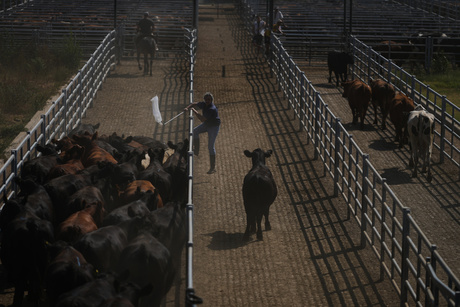
Here in Argentina, exporters reckon they'll save tens of millions of dollars a year thanks to the deal's immediate elimination of a 20% tariff on the EU's long-standing quota scheme for high-quality meat imports.
It's a breakthrough for Argentina, a nation dominated for decades by left-leaning populist governments that kept the economy closed to the outside world and prioritized the domestic market to the extent of imposing taxes on farm exports to keep food prices down.
"We're in the midst of a paradigm shift here," said Carlos Colombo, the president of Cañuelas Cattle Market in Buenos Aires province where over 12,000 cattle are sold daily, many destined for Europe and China. "Argentina has reopened itself to the world."
Argentine President Javier Milei may be Trump's strongest ideological ally in Latin America — sharing his disdain for the United Nations and the Paris climate accord — but no one can call the radical libertarian a protectionist.
At first he derided the notoriously slow-moving Mercosur as irrelevant and threatened to ditch it. But he changed his tune since realizing the bloc's potential to sweep away tariffs and slash customs red tape.
"He sees this agreement as a way to revitalize and re-signify Mercosur," said Marcelo Elizondo, an Argentine economic analyst specializing in international trade.
The free-trade fever has also infected Brazil's long-closed economy. Apex, a Brazilian government investment agency, estimates that EU-bound agricultural exports like instant coffee, poultry and orange juice will rake in $7 billion in coming years.
Europe's farmer lobby wins concessions
Squeezed by environmental regulations and fearing a flood of cheap food products from across the Atlantic, farmers have blocked highways and descended on the streets of European capitals in an explosion of outrage against the agreement.
The EU has scrambled to soothe their concerns over decades of negotiations, adding environmental and animal welfare safeguards to the accord and imposing strict quotas for South American exports of meat and sugar to ensure homegrown produce stays competitive.
Even so, the angry farmers ultimately persuaded France, Poland and a few other states to oppose the deal in last week's internal EU vote, depriving the accord's supporters of what they hoped would be a show of unity. Italy and other agricultural powerhouses only came around after the EU offered farmers generous subsidies to the tune of $52 billion.
"It's a sizable bribe," said Jacob Funk Kirkegaard, nonresident senior fellow at the Peterson Institute for International Economics. "EU leaders decided that the deal is so important at this moment, it's worth it."
'Cows for cars'
Some have dubbed the deal "cows for cars," reflecting the perception that Europe's auto industry will also win big.
Clobbered by growing competition with China and sky-high U.S. tariffs, vaunted German auto giants like Volkswagen and BMW are glad for the boost, as are producers in Europe's pharmaceutical, construction and machinery sectors gaining access to hundreds of millions more consumers.
Experts say that the elimination of 35% tariffs on auto parts and cars gives European industrial exporters a rare chance to claw back their South American market share from cheaper Chinese rivals.
"Failing to sign the EU-Mercosur free trade agreement risked pushing Latin American economies closer to Beijing's orbit," said Agathe Demarais, a senior policy fellow with the European Council on Foreign Relations.
But many are still are holding their breath, having watched negotiations lumber along for years only to trip up at the last minute.
"There are still several steps that have to be taken ... and Europe continues to be very careful," Colombo said, straining to be heard over the hollers of cowboys prodding hundreds of bellowing cattle into trucks.
"Let's not forget, this is historic. We've never reached an agreement like this before."


