


UK Green Party election win is a nightmare for Labour and Starmer
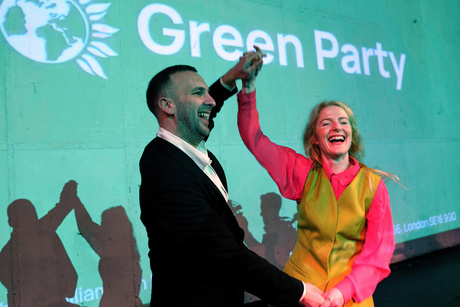
An emphatic election victory for Britain's environmentalist Green Party is a nightmare for Prime Minister Keir Starmer that raises questions about how long he will continue as leader.
Less than two years after winning power in a landslide, Starmer's center-left Labour Party not only lost a longtime stronghold in its northern England heartlands — it came third, finishing behind both the left-leaning Greens and the hard-right party Reform U.K.
Thursday's election in the Gorton and Denton constituency of Greater Manchester was for just one seat out of 650 in the House of Commons. But it's a glimpse into the messy new reality of British politics, and its consequences could be far-reaching.
Here are takeaways from the election.
Starmer is in trouble
The result is a heavy blow to Starmer, whose leadership has staggered through a series of crises and suffered a near-death experience earlier this month.
Since being elected in July 2024, Starmer has struggled to deliver promised economic growth, repair tattered public services and ease the cost of living. His government has been sidetracked by missteps and U-turns over welfare cuts and other unpopular policies.
The next national election does not have to be held until 2029, meaning the main threat to Starmer comes from within his own party. Under British rules, the governing party can change prime minister without having to go to voters.
Three weeks ago it looked like that might happen, when indirect fallout from a trove of Jeffrey Epstein files released in the United States caused discontent to boil over.
Several Labour lawmakers and the party's leader in Scotland called for Starmer to resign, his chief of staff and communications director quit, and his premiership teetered on the brink.
Starmer vowed to stay, and got a reprieve after potential leadership rivals publicly backed him. But his already precarious position is now even shakier, and he faces peril after May 7 local and regional elections, when Labour is expected to do badly.
Jon Trickett, a Labour lawmaker on the left of the party, said Friday that Starmer should "look in the mirror and make a decision about his own personal future."
Britain has a fractured political system
Green Party leader Zack Polanski said the result shows that "Labour's electoral stranglehold is over."
For a century, U.K. national politics has been dominated by two parties: the Conservatives on the right and Labour on the left. Unlike many European countries, Britain does not have a system of proportional representation, meaning that smaller parties have struggled to break through.
But that is changing. Scotland, Wales and Northern Ireland have their own distinct parties. And new parties on both left and right are snatching an increasing share of the vote.
Reform U.K., the latest party led by anti-immigration campaigner Nigel Farage, has just eight seats in the House of Commons but has topped opinion polls for months, ahead of both Labour and the Conservatives.
The Greens, under their new leader, the "eco-populist" Polanski, have broadened their message beyond environmental concerns to focus on issues including the cost of living, legalization of drugs and support for the Palestinian cause, positioning themselves as an alternative to Labour for left-liberal voters.
Newly elected lawmaker Hannah Spencer is a 34-year-old plumber who in her victory speech apologized to customers for having to cancel appointments so she could start her new job in Parliament.
She spoke of issues that should be Labour's terrain: the cost of living, frayed public services and the erosion of opportunities in former industrial areas that traditionally voted Labour.
"For people here in Gorton and Denton who feel left behind and isolated: I see you and I will fight for you," Spencer said.
Labour is caught in the middle
The result drives home Labour's predicament: It faces challenges from both left and right.
Thursday's election was in a diverse area that has traditional working-class neighborhoods — once strongly Labour, now tilting toward Reform — as well as large numbers of university students and Muslim residents. Many of them feel disillusioned by Labour's centrist shift under Starmer and the government's perceived slowness at criticizing Israel's conduct of the war against Hamas in Gaza — fertile ground for the Green Party.
Rob Ford, a professor of political science at the University of Manchester, said the result was "the nightmare scenario for the incumbent government."
"They have fallen into the electoral Valley of Death," Ford wrote on social media. "Rejected in the center. Rejected on the right. And now rejected on the left."
In the wake of the defeat, many in Labour called for a change of direction, saying efforts to win over "Reform-curious" voters with policies aimed at curbing immigration had alienated many liberal electors.
"If the Labour Party thinks it can win an election by moving on to the territory which has been occupied by Mr. Farage and his party, they've made a big mistake," Trickett told Times Radio. He said the party had made the mistake of assuming "that the progressive voters had nowhere else to go."
Jeffrey Epstein was a factor
Starmer has been tainted by fallout from scandals about Jeffrey Epstein, a man he never met and in whose crimes he's not implicated.
The leadership crisis earlier this month was sparked by revelations about the relationship between sex offender Jeffrey Epstein and Peter Mandelson, the veteran Labour politician appointed by Starmer in 2024 to be U.K. ambassador to Washington.
Police are investigating emails suggesting Mandelson passed sensitive government information to Epstein a decade and a half ago. Mandelson was arrested and questioned by detectives this week before being released on bail. He does not face any allegations of sexual misconduct.
Starmer fired Mandelson in September 2025 after evidence emerged that the ambassador had maintained a friendship with Epstein after the financier's 2008 conviction for sex offenses involving a minor. But recent revelations have stirred up Labour lawmakers' anger at Starmer's poor judgment in appointing Mandelson to the Washington job in the first place.
On Friday Starmer acknowledged the result was disappointing, but vowed to "keep on fighting."
"Incumbent governments quite often get results like that mid-term, but I do understand that voters are frustrated," he said. "They're impatient for change."


