


Spotlight
-
 Middle East
Trump says Iran has 48 hours to make deal or US will unleash 'Hell'
U.S. President Donald Trump on Saturday reminded Iran of the 10-day ultimatum he had issued for it to accept a deal that would stop the war.
"Re...
Middle East
Trump says Iran has 48 hours to make deal or US will unleash 'Hell'
U.S. President Donald Trump on Saturday reminded Iran of the 10-day ultimatum he had issued for it to accept a deal that would stop the war.
"Re...
-
 Middle East
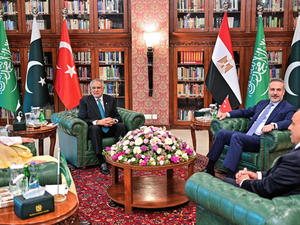
Mediators reportedly working on 'middle ground solution' between US, Iran
Mediators from Pakistan, Turkey and Egypt are still working on a ceasefire plan between the U.S. and Iran, the Israeli Public Broadcasting Corp...
1
Middle East
Mediators reportedly working on 'middle ground solution' between US, Iran
Mediators from Pakistan, Turkey and Egypt are still working on a ceasefire plan between the U.S. and Iran, the Israeli Public Broadcasting Corp...
1
-
 Middle East
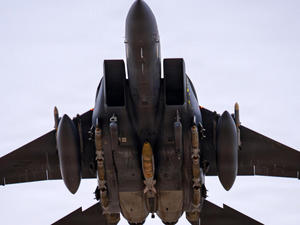
Iran, US race to find crew member of crashed American fighter jet
Iranian and American forces raced each other Saturday to recover a crew member of the first U.S. fighter jet to go down inside Iran since...
Middle East
Iran, US race to find crew member of crashed American fighter jet
Iranian and American forces raced each other Saturday to recover a crew member of the first U.S. fighter jet to go down inside Iran since...
As Israel pounds Iran with airstrikes targeting military facilities and its nuclear sites, officials in Tehran have proposed a variety of steps the Islamic Republic could take outside of launching retaliatory missile barrages.
Those proposals mirror those previously floated by Iran in confrontations with either Israel or the United States in the last few decades. They include disrupting maritime shipping through the Strait of Hormuz, potentially leaving the Nuclear Nonproliferation Treaty and attacks by allied militants.
 Full Story
If the U.S. decides to support Israel more directly in its attack on Iran, one option for Washington would be to provide the "bunker-buster" bombs believed necessary to significantly damage the Fordo nuclear fuel enrichment plant, built deeply into a mountain.
Such a bomb would have to be dropped from an American aircraft, which could have wide-ranging ramifications, including jeopardizing any chance of Iran engaging in Trump's desired talks on its nuclear program. Israeli officials have also suggested that there are other options for it to attack Fordo in central Iran as it seeks to destroy the country's nuclear capabilities.
 Full Story
Tulsi Gabbard left no doubt when she testified to Congress about Iran's nuclear program earlier this year.
The country was not building a nuclear weapon, the national intelligence director told lawmakers, and its supreme leader had not reauthorized the dormant program even though it had enriched uranium to higher levels.
 Full Story
Jeffrey Fields USC Dornsife College of Letters, Arts and Sciences
Relations between the United States and Iran have been fraught for decades – at least since the U.S. helped overthrow a democracy-minded prime minister, Mohammed Mossadegh, in August 1953. The U.S. then supported the long, repressive reign of the Shah of Iran, whose security services brutalized Iranian citizens for decades.
 Full Story
Six of the Group of Seven leaders discussed Russia's war in Ukraine and the Israel-Iran conflict but failed to reach major agreements on those and many other top issues — closing a summit that was forced to try and show how the wealthy nations' club might still shape global policy despite the early departure of U.S. President Donald Trump.
Canadian Prime Minister Mark Carney and his counterparts from the U.K., France, Germany, Italy and Japan were joined during Tuesday's final sessions by Ukrainian President Volodymyr Zelenskyy and NATO chief Mark Rutte.
 Full Story
Russian President Vladimir Putin is set to take questions Wednesday from international journalists on the sidelines of the St. Petersburg International Economic Forum.
Putin scheduled a roundtable session with senior news leaders of international news agencies, including The Associated Press. Among other issues, he's expected to spell out Moscow's position on the conflict between Israel and Iran that he offered to help mediate in a weekend call with U.S. President Donald Trump.
 Full Story
Russia poses a direct threat to the European Union through acts of sabotage and cyberattacks, but its massive military spending suggests that President Vladimir Putin also plans to use his armed forces elsewhere in the future, the EU's top diplomat warned on Wednesday.
"Russia is already a direct threat to the European Union," EU foreign policy chief Kaja Kallas said. She listed a series of Russian airspace violations, provocative military exercises, and attacks on energy grids, pipelines and undersea cables.
 Full Story
Iran’s ambassador in Geneva derided as “hostile” and “unwarranted” U.S. President Donald Trump’s comments calling for Iran’s “unconditional surrender.”
Ambassador Ali Bahreini told reporters the Israeli campaign “has not been able to bring big damage to our nuclear facilities” because it had taken precautions to protect them.
 Full Story
Iran's supreme leader Ayatollah Ali Khamenei said Wednesday the nation would never surrender as demanded by President Donald Trump and warned the United States it would face "irreparable damage" if it intervenes in support of its ally.
The speech came six days into the conflict, with Trump demanding Iran's "unconditional surrender" while boasting the United States could kill Khamenei and fueling speculation about a possible intervention.
 Full Story
U.S. President Donald Trump met his National Security Council on Tuesday to discuss the Iran-Israel war, the White House said, as the U.S. leader considered whether to join Israel's air campaign against Tehran.
 Full Story


