


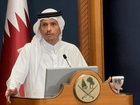
The Gulf states are unified in calling for a de-escalation of the Middle East war, Qatar said Tuesday as Tehran launched new strikes against its neighbors.
"Our understanding is that there is a very unified position in the Gulf on calling for the de-escalation and an end to the war," Qatar's foreign ministry spokesman Majed al-Ansari told a regular news briefing.
 Full Story
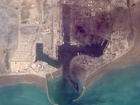
Satellite images are beginning to be released giving a glimpse into the toll of the Iran war, with ships ablaze in an Iranian port and destroyed buildings at American bases in the region.
Information has so far been scarce about the damage being done across the Middle East, particularly when it's inside closed military facilities, since the war started on Feb. 28.
 Full Story
Gulf allies of the United States, led by Saudi Arabia and the United Arab Emirates, are urging President Donald Trump to continue prosecuting the war against Iran, arguing that Tehran hasn't been weakened enough by the monthlong U.S.-led bombing campaign, according to U.S., Gulf and Israeli officials.
After private grumbling at the start of the war that they were not given adequate advance notice of the U.S.-Israeli attack and complaining the U.S. had ignored their warnings that the war would have devastating consequences for the entire region, some of the regional allies are making the case to the White House that the moment offers a historic opportunity to cripple Tehran's clerical rule once and for all.
 Full Story
Israel's parliament on Monday passed a law approving the death penalty for Palestinians convicted of murdering Israelis, a measure that has been harshly condemned by the international community and rights groups as discriminatory and inhumane.
The passage of the bill marked the culmination of a yearslong drive by the far-right to escalate punishment for Palestinians convicted of nationalistic offenses against Israelis. Prime Minister Benjamin Netanyahu came to the Knesset to vote for the bill in person.
 Full Story
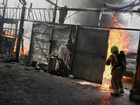
The United States hit the central Iranian city of Isfahan early Tuesday, sending a massive fireball into the sky, and Tehran struck a fully loaded Kuwaiti oil tanker in the Persian Gulf.
The attacks were testament to the intensity of the monthlong war the U.S. and Israel launched against Iran, which has maintained its chokehold on the Strait of Hormuz, closing off the vital waterway for global energy shipments, sending oil prices skyrocketing and roiling world markets.
 Full Story
U.S. Secretary of State Marco Rubio on Monday voiced hope for working with elements within Iran's government, saying the United States privately had received positive messages, AFP reported.
Rubio said there were internal "fractures" inside Iran and that the United States hoped that figures with "power to deliver" take charge.
 Full Story
U.S. President Donald Trump said Monday that the United States is in "serious discussions" with "a new, and more reasonable, regime" in Iran with the aim of ending "military operations."
 Full Story
Spain has closed its airspace to U.S. planes involved in the Iran war, Defense Minister Margarita Robles said Monday, marking another step in the country's opposition to the U.S. and Israel's conflict in the Middle East.
Spain had already said the U.S. could not use jointly operated military bases in the Iran conflict, which Spanish Prime Minister Pedro Sánchez has described as illegal, reckless and unjust.
 Full Story
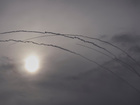
Sirens sounded at dawn near Israel's main nuclear research center, a part of the country that has been targeted repeatedly in recent days. Israel's military also said it had taken out two drones launched from Yemen, where the Iranian-backed Houthi rebels entered the war on Saturday with their first missile attack.
Later, a fire broke out at an oil refinery in the northern city of Haifa, one of only two in Israel, either from a missile strike or from debris falling from an interception. The blaze was quickly extinguished.
 Full Story
Israel's parliament on Monday passed its annual budget in a marathon overnight session, ensuring that Prime Minister Benjamin Netanyahu's government can complete its term until the fall.
Israel needed to pass a budget before April 1 in order to avoid triggering early elections. Netanyahu still reserves the right to call early elections before then if he wants.
 Full Story


