


Lithuania declares national emergency over security risks posed by Belarus balloons
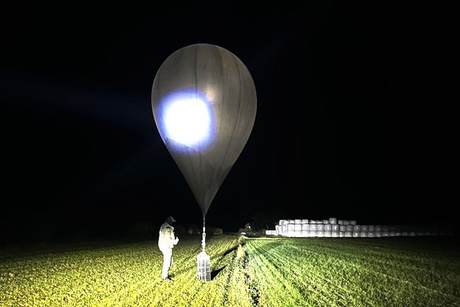
Lithuania's government on Tuesday declared a national emergency over security risks posed by meteorological balloons from Russia-allied Belarus that have violated its airspace in recent weeks.
Tensions between Lithuania and Belarus have escalated after the balloons forced Lithuania to repeatedly shut down its main airport, leaving thousands of people stranded.
"In combating the Belarusian hybrid attack, we must take the strictest measures and defend the areas most affected by this attack," Prime Minister Inga Ruginienė said.
The announcement followed a Cabinet meeting of the Baltic state, which is a NATO member and strong backer of Ukraine in its fight against the Russian forces who launched a full-scale invasion in February 2022.
Interior Minister Vladislav Kondratovič said that the state of emergency means the army would be given the possibility to patrol in the border area, together with police and other uniformed services or alone, in order to detect the balloons.
He promised the impact on civilians would be limited.
While the balloons are used to smuggle cigarettes into Lithuania, officials in Vilnius see their numbers and trajectories as deliberate acts of disruption orchestrated by Belarus.
Kondratovič said Lithuanian prosecutors launched an investigation into the balloons and that the secret services would provide information about the connection with the Minsk regime.
"I have no information that the Belarusian side is trying to curb the senders of the balloons," the minister said. "And this is one of the proofs that this is a hybrid attack."
In October, Lithuanian authorities closed two border crossings in response to the airspace violations by the balloons.
Belarus' authoritarian President Alexander Lukashenko denounced Lithuania's move to close the border as a "mad scam" and part of a "hybrid war" against his country. He suggested that Vilnius itself needs to combat smuggling of contraband.
Lithuania, Poland and other European Union countries in the region have in recent years accused Belarus of other activity aimed at triggering instability, including with cyberattacks. They also accuse Minsk of directing a large influx of migrants from the Middle East and Africa to their borders to create a migration crisis.
"Belarus is signalling to Lithuania that it can raise the price at any moment," Linas Kojala, head of the Geopolitics and Security Studies Center in Vilnius, told The Associated Press. "Yesterday with weaponized migration, today with balloons that are hardly separable from regime control."
Europe overall has been on high alert since drone intrusions into NATO's airspace reached an unprecedented scale in September and the Russian invasion of Ukraine nears its fourth year. However, smuggling balloons are a challenge unique to the Baltic states bordering Belarus.
Representatives of the EU and NATO have expressed support but offered scarce concrete information about what could be done.
"We will sooner or later have to find ways to neutralize these balloons," Kondratovič, the interior minister, said. "According to our data, no country has a solution for shooting down a balloon at an altitude of 10 kilometers (6 miles) using a drone or other kinetic tool," he told Lithuania's public broadcaster, LRT.
According to the Lithuanian government, since October, the Vilnius international airport has been closed for more than 60 hours due to the threat posed to civil aviation by the balloons, affecting over 350 flights and approximately 51,000 passengers.


