


Indonesia tightens control on nickel as US and China scramble for critical minerals
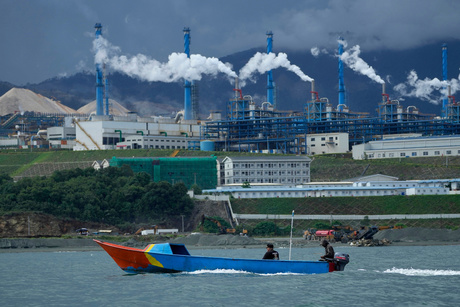
Indonesia is tightening state control over the world's largest nickel supply after years of betting the metal would anchor a homegrown electric-vehicle industry, and just as global demand begins shifting away from heavy reliance on nickel.
The move could still ripple through global EV supply chains as the United States and China compete for critical minerals. Indonesia sits at the center of the nickel market: its share of global supply jumped to about 60% in 2024 from 31.5% in 2020, according to S&P Global Market Intelligence, after former President Joko Widodo banned raw ore exports, drawing a surge of Chinese-backed investment into refining.
Jakarta hoped that control over nickel would underpin a fully domestic EV industry, from mining and batteries to finished cars. Experts say that promise was used to justify forest clearing and mining expansion in the name of the energy transition, even as climate risks deepened.
In 2025, Indonesia cracked down on what it called illegal exploitation of natural resources, saying many mining and plantation licenses were tainted by bribery or never properly approved. Authorities say they have seized more than 4 million hectares (9.8 million acres) of mines, palm oil plantations and processing sites, levied $1.7 billion in fines, and could seize another 4.5 million hectares this year.
But analysts warn the crackdown is coming just as nickel's payoff is starting to fade, with many Chinese EVs shifting to battery chemistries that use far less of the metal, relying instead on iron-based designs.
"The forests have been exploited to the brim," said Putra Adhiguna of the Jakarta-based Energy Shift Institute. "But you never got the electric-vehicle value chain."
Indonesia's pays an environmental cost
China plays the leading role in Indonesia's nickel sector, using the metal to underpin its stainless steel and clean-energy industries.
The world's largest nickel reserves are concentrated on the Indonesian island of Sulawesi, which accounts for more than half of global nickel mine production, according to the U.S.-based Institute for Energy Economics and Financial Analysis or IEEFA.
China has sourced nickel from Indonesia for decades, but the relationship deepened after Jakarta banned raw ore exports in 2020, drawing a surge of Chinese investment into smelters.
Nickel shipments to China jumped, with imports of nickel matte — a semiprocessed material used in battery chemicals and alloys — rising nearly 28-fold between 2020 and 2023, more than 90% of it from Indonesia, according to trade data. Over the same period, North and South America's combined share of global nickel output fell from 16% to 7%, while Europe's share dropped from 35% to 10%, according to the International Nickel Study Group, a Lisbon-based intergovernmental organization.
Meanwhile, mining drove the loss of about 370,000 hectares (roughly 914,000 acres) of Indonesian forests between 2001 and 2020 — more than in any other country — according to an analysis by the World Resources Institute. More than a third of that loss was old-growth rainforests which hold vast carbon stocks and are crucial for limiting climate change.
The heavy use of coal to run Indonesia's nickel smelters has also slowed the country's energy transition, adding new fossil-fuel demand even as it tries to cut emissions. A 2024 analysis by the IEEFA found that major nickel producers emitted about 15 million metric tons (16.5 million U.S. tons) of greenhouse gases in 2023, largely because of coal reliance.
In one of the most public nickel-related seizures last year, Indonesian soldiers accompanied by a local television crew, took control of part of the world's largest nickel mine.
Mostly owned by Chinese metals giant Tsingshan Holding Group, the mine has caused deforestation, air and water pollution and increased coal-fired emissions, while displacing communities, harming livelihoods and exposing residents to health risks, according to a 2024 report by the nonprofit group Climate Rights International.
The move wasn't aimed at environmental protection or restoring forestry safeguards, said Bhima Yudhistira, with the Jakarta-based Center of Economic and Law Studies or CELIOS.
"There is no guarantee things will get better," he said. They could get "even worse."
Indonesia bet on EV batteries but the market shifted
Indonesia's effort to turn its nickel reserves into the backbone of a domestic EV industry drew early interest from investors in South Korea and China but has fallen short of expectations.
In July 2024, South Korea's Hyundai Motor Group and LG Energy Solution opened Indonesia's first EV battery-cell plant, with annual capacity to supply more than 150,000 electric vehicles. But in April 2025, LG Energy Solution withdrew from a larger $8.4 billion battery investment, citing market and investment conditions.
An EV plant is still being built by Chinese automaker BYD. China's CATL, the world's largest EV battery maker is constructing a battery factory with Indonesian state firms.
Indonesia's EV market, is growing quickly but remains small.
The country sold more than 43,000 electric vehicles in 2024, accounting for about 5% of total car sales, according to the Indonesian Business Council. Public charging infrastructure is limited, with around 1,500 stations nationwide in 2024.
Even if Indonesia produced 1 million EVs a year — equal to total annual auto sales — and favored nickel-rich batteries, that would still consume less than 1% of its national nickel output, according to the Energy Shift Institute.
EV makers are shifting to lithium iron phosphate, or LFP, batteries, reducing the need for nickel and cobalt. LFP batteries are cheaper, more stable and longer lasting. They're used in nearly half of all EVs, the International Energy Agency found.
Indonesia is caught between Washington and Beijing
Analysts say Indonesia's nationalization drive could loosen Beijing's grip on parts of the supply chain, potentially giving Jakarta more leverage to court U.S. buyers and investors.
One potential concession by Indonesia in long drawn-out trade negotiations with the administration of U.S. President Donald Trump, expected to wrap up soon, would be to lift the ban on raw nickel exports to the U.S.
Indonesia already has invited the U.S. to invest in its critical minerals sector as part of ongoing tariff negotiations between the two countries, though it's caught in a tricky position.
"How does Indonesia straddle between the two superpowers who both want to gain control of the national resource that Indonesia has?" said Li Shuo, director of the Asia Society Policy Institute's China Climate Hub.
Other Southeast Asian countries similarly "sandwiched" between the U.S. and China are watching Indonesia closely, Li said.
"Make no mistake, it's going to be very difficult," he said.
Indonesia's land seizures risks further destabilizing its nickel industry, added Yudhistira with CELIOS. Foreign investors monitoring the situation are likely to hesitate before committing new capital to Indonesia-based mining and processing projects, he said.
"This is making the future of nickel, both mining and downstream processing, unknown," Yudhistira said. "Uncertainty is very costly for investors."


