


China says will play 'greater role' in ending Mideast fighting
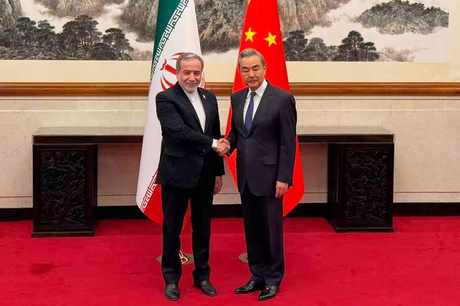
China's Foreign Minister Wang Yi said Beijing would play a "greater role" in ending hostilities in the Middle East during talks with his Iranian counterpart on Wednesday, a week before U.S. President Donald Trump is due to meet Xi Jinping.
China is a key customer for Iranian oil, defying sanctions imposed by the United States, and is directly affected by the blockage of the Strait of Hormuz bordered by Iran.
Beijing has quietly engaged in efforts to resolve the weekslong crisis and its diplomacy is credited with playing an important role in the fragile ceasefire agreed between Washington and Tehran.
China "will work harder to ease tensions and end the fighting, continue to support the launch of peace talks, and play a greater role in restoring peace and tranquility to the Middle East", Wang told Iran's Abbas Araghchi in Beijing.
"China considers that a complete cessation of fighting must be achieved without delay, that it is even more unacceptable to restart hostilities, and that continuing to negotiate remains essential," Wang said, according to a statement from his ministry after the talks.
Manufacturing giant China has been comparatively sheltered from fuel shortages thanks to oil reserves and renewable energy, but costs of oil-derived materials like plastic and fabric have risen significantly.
More than half of the crude imported by sea to China comes from the Middle East and mainly transits through the Hormuz strait, according to maritime analytics firm Kpler.
Analysts have warned the war's impact on China will be felt for months.
During Wednesday's talks Wang said China hopes "the parties concerned will respond as quickly as possible to the urgent call of the international community" for a resumption of normal and safe maritime traffic through the Strait of Hormuz.
- Trump trip looms -
The Wang-Araghchi talks came as Trump said the U.S. would pause escorting commercial ships through the Hormuz Strait -- which drew Iranian attacks -- barely a day after it began doing so.
Trump cited a desire to reach a peace deal with Iran.
Washington demands tight controls on Tehran's nuclear program, which Iran has refused to agree to and has led to talks crumbling.
"On the nuclear issue, China welcomes Iran's commitment not to develop nuclear weapons, while considering that Iran has the legitimate right to the peaceful use of nuclear energy," Wang said.
The U.S. leader is expected to meet Chinese President Xi in Beijing on a visit the White House said will take place May 14-15.
Beijing has not confirmed those dates.
A foreign ministry spokesman again refused to share details when asked about Trump's visit at a regular news conference on Wednesday.
Trump would join rulers from the Gulf, Europe and Southeast Asia that have recently landed face time with Xi, who has sought to position China as a stable partner in the face of the U.S.- and Israeli-led conflict.
Trump's visit would also come more than a year after his sweeping global tariffs wreaked havoc on the supply chain, causing chaos in China's manufacturing sector.
