


Constitutional Council suspends general amnesty law
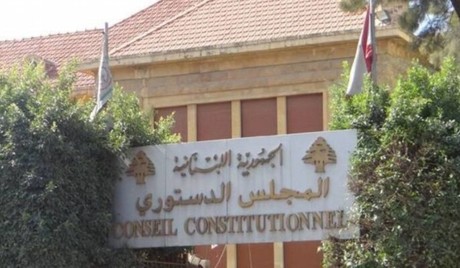
The Constitutional Council on Thursday issued a decision suspending the effect of the general amnesty law that was recently approved by parliament, after an appeal was filed against the law by the Free Patriotic Movement-led Strong Lebanon bloc.
The law will remain suspended until the council issues a final verdict.
“After deliberating on the challenge filed … the Council decided -- by a majority vote -- to suspend the effect of the contested law. It was also decided to formally notify the President of the Republic, the Speaker of Parliament, and the Prime Minister of this decision, and to publish it in the Official Gazette,” the decision said.
FPM chief Gebran Bassil noted Wednesday that the law would grant amnesty to perpetrators of murder, rape, attacks against the army and other offenses.
"Our goal is to amend the law so that it specifically targets the limited number of aggrieved Islamists who have remained untried for years,” Bassil said.
He emphasized that "defending the army is a duty, not a stance against any specific sect.”
“The military’s martyrs hail from diverse sects, with the majority being Sunni," Bassil pointed out. He added: "We want to reassure military personnel that when they are deployed on a mission, those who kill them will not be granted amnesty. This matter concerns not just the army or a particular sect, but Lebanon as a whole."
 11 September 2026, 04:00
10
11 September 2026, 04:00
10
No, Lebanon does not have a single Supreme Court that sits at the apex of all four branches to resolve overlapping conflicts or unify their jurisprudence. Because the systems are structurally isolated from one another, jurisdictional turf wars and conflicting judgments frequently happen without a single, ultimate arbiter to permanently resolve them. Instead, conflicts across the systems are handled through localized, fragmented mechanisms: (Google)
11 September 2026, 04:02
10
Instead of a single overarching structure, Lebanon's judiciary is divided into four main court systems, each handling distinct areas of law: 1. The Ordinary Court System (Kadaa'dli)This branch handles standard civil and criminal disputes. It operates on a three-tier hierarchy. 2. The Administrative Court System (Majlis al-Shura)Headed by the State Council, this independent branch handles legal disputes involving public administrations, government decisions, and state accountability. 3. The Religious Court SystemBecause Lebanon officially recognizes 18 different religious sects, personal status matters—such as marriage, divorce, custody, and inheritance—are entirely bypassed by the civil courts. Instead, they are handled by standalone religious courts run by clergy members belonging to specific Christian, Muslim, or Druze authorities.
11 September 2026, 04:03
10
4. Special and Exceptional CourtsLebanon maintains specific tribunals for specialized subject matters, most notably the Military Court, which prosecutes cases involving the military, state security, espionage, or civilians involved in security-related incidents. (Note: In Lebanon's civil law tradition, legal arguments are conducted primarily through written submissions rather than oral debates, and trial by jury does not exist.) Would you like to know more about how judges are appointed to the Supreme Judicial Council, or are you interested in recent legal reforms passed regarding judicial independence


