


Xi warns Trump on Taiwan, vows not to arm Iran
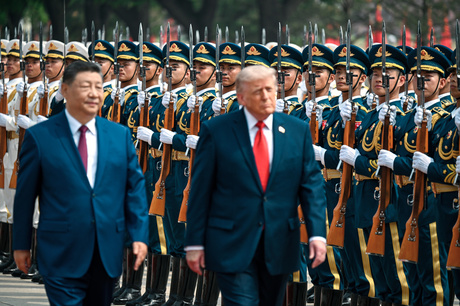
Chinese President Xi Jinping warned his U.S. counterpart Donald Trump that missteps on Taiwan could push their two countries into "conflict", a stark opening salvo as they met Thursday at a superpower summit in Beijing.
Trump arrived in China with accolades for his host, calling Xi a "great leader" and "friend" and extending an invitation to visit the White House in September.
Beyond the pomp as he welcomed Trump, Xi in less effusive tones said the two sides "should be partners and not rivals", and quickly highlighted the issue of Taiwan -- which Beijing claims as its territory.
"The Taiwan question is the most important issue in China-U.S. relations," Xi said, according to remarks published by Chinese state media shortly after the start of the talks, which lasted two hours and 15 minutes.
"If mishandled, the two nations could collide or even come into conflict, pushing the entire China-U.S. relationship into a highly perilous situation," Xi added.
Trump's trip to Beijing is the first by a U.S. president in nearly a decade, with the grand reception belying a roster of unresolved trade and geopolitical tensions.
Xi greeted Trump with a red-carpet welcome at the opulent Great Hall of the People, with military band fanfare, a 21-gun salute and schoolchildren chanting "Welcome!"
Seemingly enjoying the ceremony, the 79-year-old Trump said "the relationship between China and the USA is going to be better than ever before".
Xi, who at 72 has led China for more than 13 years, instead referenced a political theory about the risks of war when a rising power rivals a ruling one, inspired by an ancient Greek historian.
"Can China and the United States transcend the so-called 'Thucydides Trap' and forge a new paradigm for major-power relations?" Xi asked.
At a state banquet in the evening, the Chinese leader insisted it was possible.
"Achieving the great rejuvenation of the Chinese nation and making America great again can totally go hand in hand... and advance the wellbeing of the whole world," Xi said, in reference to Trump's MAGA movement.
- 'Blunt language' -
But there are longstanding hurdles to overcome, with Taiwan looming large.
The United States recognises only Beijing but under U.S. law is required to provide weapons to the self-ruled democracy for its defense.
China has sworn to take the island and has not ruled out using force, ramping up military pressure in recent years.
Following Xi's Thursday comments, Taipei called China the "sole risk" to regional peace, and insisted "the U.S. side has repeatedly reaffirmed its clear and firm support".
Trump had said Monday he would speak to Xi about U.S. arms sales to Taiwan, a departure from Washington's previous insistence that it will not consult Beijing on the matter.
The White House said Thursday's initial talks had been "good", though it did not mention Taiwan in the readout.
Adam Ni, editor of newsletter China Neican, told AFP that while Xi's "blunt language" was not uncommon in party state media, it was unusual coming from the leader himself.
China has been "signalling a desire for U.S. compromise on Taiwan", the National University of Singapore's Chong Ja Ian told AFP.
Xi's demand could suggest "they see some opportunity to convince Trump", he said.
U.S. Treasury Secretary Scott Bessent told CNBC the president would say more on Taiwan "in the coming days".
- Iran overshadows -
Trump told Fox News that Xi had offered China's help to open the Hormuz Strait -- the key oil route largely blocked since the U.S.-Iran war erupted -- and that Xi had also pledged not to send military equipment to aid Iran.
"He said he's not going to give military equipment... he said that strongly," Trump told the "Hannity" show. "He'd like to see the Hormuz Strait open, and said 'if I can be of any help whatsoever, I would like to help.'"
Meanwhile Iran's Revolutionary Guards said naval forces had allowed multiple Chinese ships to pass through the strait since Wednesday night.
China's foreign ministry said the Middle East had been discussed but did not give further details.
The two leaders also discussed economic cooperation, with Trump hoping for business deals on agriculture and other sectors.
He told Fox that China had agreed to purchase 200 Boeing jets, a deal that would equate to "a lot of jobs."
U.S. media had described a possible China order of 600 jets, however.
Boeing's CEO Kelly Ortberg was among the elite businessmen in the U.S. delegation, which also included Nvidia's Jensen Huang and Tesla's Elon Musk.
At the state banquet Trump said the talks had been "extremely positive", describing the evening ahead as "another cherished opportunity to discuss among friends."


