


Indonesia intensifies aerial firefighting as forest fires scorch multiple provinces
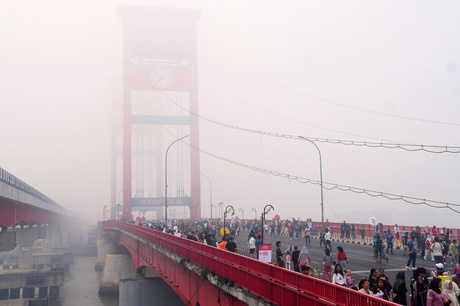
Indonesia on Monday intensified ground and aerial firefighting operations as huge blazes in central and western parts of the country scorched thousands of hectares of forests and peatland, created a choking haze that blanketed cities and crossed borders.
Indonesian authorities have been battling fires driven by an intensifying El Nino pattern and a prolonged dry season, generating dense smoke that crossed into Malaysia and Brunei, according to Indonesia's National Disaster Management Agency, or BNPB.
The BNPB said Monday that fires remain active in several regions, while large-scale suppression efforts continue in fire-prone provinces including West, Central and South Kalimantan on Borneo island and in Riau, South Sumatra and Jambi on Sumatra island. The fires are part of a broader surge in wildfire activity across Indonesia this year.
After visiting areas devastated by forest and peatland fires in Central Kalimantan on Saturday, Indonesian President Prabowo Subianto flew to fire-affected Riau province on Sumatra island, where more than 11,500 hectares (28,400 acres) have burned, to encourage authorities to get the haze cloud under control.
Prabowo vowed the government would continue supporting firefighting operations, including through the deployment of additional water-bombing helicopters and oxygen supplies for firefighters. He urged authorities to "thoroughly document and report the work being carried out by firefighting teams" directly to him.
The Transportation Ministry said it has authorized the use of 35 foreign-registered aircraft to support wildfire response operations, including water-bombing missions and aerial patrols. The ministry said the aircraft can be rapidly redeployed to disaster-hit areas as conditions change, while complying with Indonesian aviation safety regulations.
The Environment Ministry satellite data on Monday showed South Sumatra recorded the highest number of hot spots nationwide with 1,429, followed by West Kalimantan with 1,226 and Central Kalimantan with 811. East Kalimantan logged 576 hot spots, ahead of Riau with 503, while West Papua and Jambi recorded 468 and 458 hot spots, respectively.
Forestry Ministry data indicated that nearly 94,000 hectares (232,000 acres) burned in July alone.
Drought, strong winds and dry vegetation have complicated efforts to contain the fires, BNPB said in a statement on Monday. Some hot spots remained inaccessible to more than 10,700 ground firefighters who were deployed as of Sunday, prompting local officials to request additional water-bombing support and firefighting vehicles.
Cloud-seeding resumed over Kalimantan on Monday, with 30 helicopters for water-bombing and aerial patrol missions, and another 22 helicopters covering Sumatra.
Fires are a regular problem during dry season in Indonesia, a vast archipelago nation of more than 17,000 islands, and often strain relations with neighbors. Plantation owners and traditional farmers often start fires to clear land for farming. It triggers hazardous haze that reduces visibility, disrupts land and air transportation and threatens public health, sometimes affecting neighboring countries in Southeast Asia.
Meanwhile, Malaysia has suffered severe smoke from the fires, with its eastern state of Sarawak among the hardest hit, prompting the closure of nearly 600 schools and affecting about 200,000 students, the Sarawak government said.


