


World powers gather in Pacific to chart climate battle
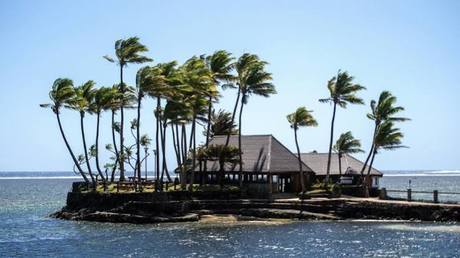
World powers are flying delegates to the Pacific to haggle over the fight against global warming, and to see the plight of island nations surrounded by a rising ocean.
Ministers, climate negotiators and a handful of leaders will meet in the Fijian city of Nadi for the October 5-8 talks.
They will be charting the course for a major U.N.-sponsored global climate summit, known as COP31, to be held in November in Turkey's Antalya province.
For Pacific nations, hosting the preliminary talks in their region offers an opportunity to draw the world's attention to life on the frontline of climate change.
Pacific leaders are pushing for the world to stick to a target of limiting global warming to 1.5C, enhance access to climate finance, and give more attention to the impact on oceans.
The sea level is rising at a record pace, driven by warming oceans and glacier melt, according to a UN report.
Up to 1.2 billion people could be displaced by 2050, with Pacific island countries experiencing sea level rise at twice the global average, said the report released in August.
It also highlighted a financing gap, with developing countries needing US$310-US$365 billion to adapt, yet having only US$26 billion in adaptation finance available in 2023.
Top delegates to the Pacific talks will hold a one-day retreat on low-lying Tuvalu, a small island nation laying plans to relocate the population if it is consumed by the ocean.
They will be shown Tuvalu's land reclamation efforts.
The island capital Funafuti's highest point is just two meters above sea-level, and two of its nine coral atolls are already largely swamped by rising seas.
- 'Act now' -
"Sea-level rise is not a future threat, it is a present reality," Tuvalu Prime Minister Feleti Teo told the UN General Assembly ahead of the climate talks.
"Tuvalu's message is clear: the world must act now decisively, collectively, and with urgency to protect the future for generations to come."
Last year, Australia bowed out of a contest with Turkey to host the COP31 summit in a deal that let it preside over negotiations and bring the preparatory talks to the Pacific.
As leader of the climate talks, however, major coal exporter Australia has faced heat over the scale of its fossil fuel extraction.
Chris Bowen, the country's climate minister, says Australia is rapidly expanding its renewable energy sources, which are essential for a transition away from fossil fuels.
Bowen, president of the COP31 negotiations, also rejected media criticism that the pre-COP talks in the Pacific had failed to lure enough world leaders.
Fewer than a dozen world leaders have so far publicly confirmed that they will attend the meetings in Fiji and Tuvalu, mostly from the Pacific.
Fiji said last month it expected the heads of state for Antigua and Barbuda, Cape Verde, Thailand, the Maldives and Timor-Leste would attend.
"It's not normally a leaders meeting," Bowen told reporters in the run-up to the talks, which are usually held at the ministerial and senior-negotiator level.
- 'Very, very sad' -
Organizers have not released detailed figures on attendance.
Bowen said last month 4,000 people from 60 nations would attend, without providing a full breakdown.
Marine scientist Rajneel Singh -- part of a team that reported large-scale coral death around Tuvalu from a 2024 marine heatwave -- said he was disheartened by a perceived lack of attention to the climate challenge.
"It's very, very sad. There's no awareness of what's happening," Singh told AFP.
Nepal's foreign minister, Shisir Khanal, has confirmed he will attend the Pacific climate meeting, after the August 26 Himalayan flood disaster.
A tsunami-like wall of water and debris triggered by a glacial and rock collapse on the Nepal-China border on August 26 killed nearly 1,500 and left 5,800 missing in the two countries.
"What we're trying to convey to the world is this: these issues of climate change are not theoretical anymore," Khanal told AFP in an interview in New York.


