


France moves aircraft carrier group toward Hormuz Strait for possible defensive mission
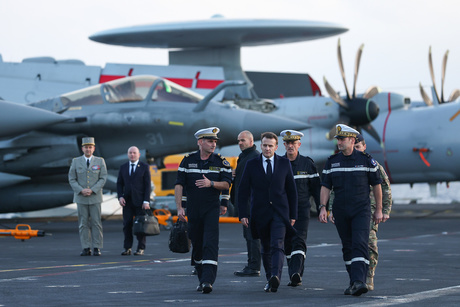
France's aircraft carrier strike group is moving south of the Suez Canal and into the Red Sea in preparation for a potential French-British mission in the Strait of Hormuz, French President Emmanuel Macron said Wednesday.
The deployment puts Europe's most powerful warship closer to the strait whose effective closure has come to epitomize the war in Iran, stranding hundreds of ships and triggering what the International Energy Agency calls the largest supply disruption in the history of the global oil market.
The defensive effort is distinct from the U.S. "Project Freedom" that launched Monday and was paused by President Donald Trump on Tuesday evening.
The repositioning of the nuclear-powered Charles de Gaulle and its escorts comes as part of a proposed mission championed by France and Britain to restore maritime security in the Strait of Hormuz as soon as conditions allow.
It "may help restore confidence among shipowners and insurers," Macron said on X. "It remains distinct from the parties at war."
Macron, who spoke with Iranian President Masoud Pezeshkian on Wednesday, said he also intends to raise the matter with Trump.
"A return to calm in the Strait will help advance negotiations on nuclear issues, ballistic matters, and the regional situation," Macron wrote. "Europeans… will play their part."
Col. Guillaume Vernet, spokesperson for the French armed forces chief of staff, stressed that the Hormuz coalition — drawn up by France, Britain and more than 50 nations — will not begin operating until two thresholds are cleared: The threat to shipping must come down, and the maritime industry must be reassured enough to use the strait.
Even then, he told The Associated Press, any operation would require the agreement of neighboring countries. That would include Iran, which borders the strait and effectively closed it by attacking and threatening ships after the war began on Feb. 28 with attacks by the U.S. and Israel.
Vernet did not specify when the carrier would reach its destination. He said the carrier was being positioned to be close enough to act if and when the conditions are met: "The French position is the same since the beginning — defensive posture, respecting international law."
War-risk insurance premiums for transits of the strait have risen four to five times above preconflict levels, according to industry estimates.
For now, insurance premiums are so high that "not a single ship will jeopardize their trip or go there," Vernet said.
Washington has not been part of the French-British planning, which observers have said echoes the European "coalition of the willing" that Macron and British Prime Minister Keir Starmer assembled to support Ukraine.
"We want to send the message that not only are we ready to secure the Strait of Hormuz, but that we are also capable of doing so," a French top official said, speaking anonymously in line with the French presidency's customary practices.
Early in the war, France sought a multinational initiative to reestablish freedom of navigation in the strait. Macron and Starmer hosted dozens of countries at a Paris summit on April 17, and military planners from more than 30 nations later finalized operational details.
The Charles de Gaulle had been ordered from the Baltic to the eastern Mediterranean soon after the war began in what the French presidency described as an "unprecedented" mobilization that also includes eight frigates and two Mistral-class amphibious assault ships.
Meanwhile, French Rafale fighters based at Al Dhafra airbase in the United Arab Emirates have been intercepting Iranian drones and missiles over the Gulf state since the war began under a long-standing defense pact with Abu Dhabi that puts some 900 French personnel on the Gulf's southern shore.
