


US-Iran deal leaves major Lebanon questions unresolved
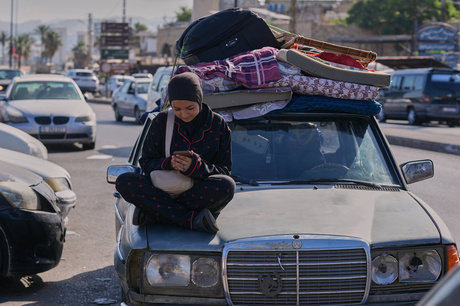
A deal between Washington and Tehran that ends the Israel-Hezbollah war leaves many issues in Lebanon unresolved, failing to mention Israel withdrawing from the country or an end to Tehran's support for the militant group.
Under U.S. pressure, Lebanese officials have been holding direct talks with Israel aimed at reaching a separate agreement on ending the hostilities, but Beirut appeared to have been sidelined with the overnight announcement on the regional conflict.
- What does the deal involve? -
Details of the agreement to end the Middle East war on all fronts have not been made public, but Iran and mediator Pakistan have both said it includes Lebanon.
Hezbollah drew the country into the Middle East war on March 2 with rocket fire at Israel to avenge the killing of Iran's supreme leader in U.S.-Israeli strikes.
Israel responded with airstrikes and a ground invasion that Lebanon says have killed more than 3,700 people and displaced more than one million others.
An official source told AFP that "Lebanon was not informed of the terms of the agreement or the time of the ceasefire".
Speaker Nabih Berri, a Hezbollah ally and intermediary for the group, thanked Washington and Tehran for their "insistence on including... an essential and binding clause on halting the Israeli aggression on all of Lebanon".
Hezbollah on Monday had so far not claimed any fresh attacks on Israeli targets.
- Israeli withdrawal? -
Information circulating about the deal does not mention any Israeli withdrawal from south Lebanon, and Israeli Defense Minister Israel Katz on Monday said forces would remain in the country indefinitely.
Karim Bitar, a lecturer in Middle East Studies at the Sciences Po university in Paris, said that "the deal does not seem to involve Israel, which immediately meant that it wasn't a party to it... So it's very unlikely that there will be an Israeli withdrawal from south Lebanon."
Israeli forces control a strip of Lebanese territory running along the entire border.
A Western military source told AFP that Israeli forces had crossed the Litani River at several points, referring to the waterway running about 30 kilometers (20 miles) from the frontier but closer in some areas.
"Tens of thousands of Israeli soldiers" are in south Lebanon where they hold some established positions, the source said, adding that Hezbollah still had a presence there.
"It's the biggest invasion since their withdrawal in 2000," the source said, referring to Israel's previous pullout after some two decades of occupation.
Hezbollah says it sent reinforcements south of the Litani after the latest war erupted.
Under a 2024 ceasefire that followed a previous round of hostilities, Hezbollah fighters were supposed to withdraw from the area.
- What future for Hezbollah? -
Washington has pressured Lebanese authorities to disarm Hezbollah for months, but the accord makes no mention of the militants.
"Iran doesn't seem to have committed to ending its support and financing for Hezbollah," Bitar said.
Military expert Riad Kahwaji said that "Hezbollah will not agree to give up arms... and this crisis will be protracted."
He said this could lead to political instability and even unrest, "especially now Hezbollah believes that through Iran it has emerged victorious from this agreement, and therefore is going to try and dictate its terms on who rules."
- Israel-Lebanon negotiations? -
Lebanon and Israel have been holding direct talks in Washington since April, seeking to end the hostilities and to separate Lebanon from the regional war.
A new round is scheduled for later this month.
LPrime Minister Nawaf Salam said Monday that "we will redouble our efforts" through the Washington negotiations "to secure a full Israeli withdrawal."
But after the Iran-U.S. announcement, some cast doubt on the effectiveness of the bilateral negotiations.
Bitar said that "Lebanon could find itself once again as a scapegoat that pays the price both of American amateurism, Iranian cynicism, Israeli hubris and... the lack of a clear strategy from its own political class."


