


In south Lebanon, Israel flag and checkpoint mark start of occupation
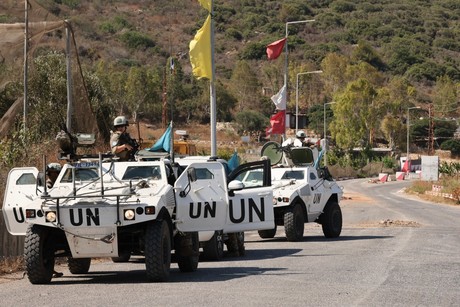
On the road to south Lebanon's coastal town of Naqoura, an Israeli flag hung over the deep blue sea, a stone's throw away from a metallic grid marking the Israeli-announced "security zone".
"Turn around, you don't have permission to pass," an Israeli soldier said through a loudspeaker to a convoy of journalists, including AFP, who joined a Christian NGO on an organized tour of still-inhabited villages in the occupied area.
The organization, which regularly provides aid and support to Christian towns in southern Lebanon, had secured the required permits from United Nations peacekeepers (UNIFIL).
AFP journalists witnessed for the first time -- after previously being blocked by fighting -- Israeli flags and soldiers on the road leading to Naqoura, more than five kilometers from the last Lebanese army position.
Lebanese flags and yellow Hezbollah banners were also raised on the side of the road. They were torn with their colors fading after months of war between Hezbollah and Israel.
The area between the Lebanese and Israeli militaries resembled a no man's land, with only the occasional UNIFIL troop patrols.
Near the newly erected yellow iron gate, with earth mounds blocking the road, an AFP team saw at least three Israeli soldiers on the balcony of a two-story house.
One ordered the convoy to turn back while another watched through binoculars. A third soldier appeared to be wearing a tallit, the Jewish prayer shawl.
AFP photos showed netting surrounding the balcony, likely a precautionary measure against drones, which Iran-backed Hezbollah has increasingly used in its attacks against Israeli forces.
- 'For all of Lebanon' -
L'Oeuvre d'Orient, the Catholic NGO, had been planning to head to the southern Christian villages of Debl, Rmeish and Ain Ebel, to inaugurate a sports zone with joint funding from the French UNIFIL battalion, to create an outlet for young people still living in the area, where it is forbidden to enter or leave without prior permission.
The convoy went back a few kilometers and waited for several hours near an Italian battalion base.
The organization, which has made several trips to Lebanon's few inhabited Christian southern towns over the past months to deliver aid, then informed journalists that Israel had refused to let them join.
A force from the French battalion went alone to inaugurate the center.
Hugues de Woillemont, head of the organization in France, expressed regret over not being able to go, as he wished to tell the villages "we did not forget them".
Vincent Gelot, the organization's director in Lebanon, said that "without these villages, there would no longer be Lebanese in this part of Lebanon", referring to the largely depopulated Shia-majority area.
"Their presence is therefore a presence for all of Lebanon, not just for the Christians."
On June 18, the day after Tehran and Washington signed a memorandum of understanding that included a ceasefire in Lebanon, Israel's military published a map of what it called a "security zone".
It is an area stretching around 10 kilometers inside Lebanese territory where Israeli troops are operating, and includes dozens of towns and villages, including Naqoura, home to the UNIFIL headquarters.
In late June, Lebanon and Israel reached a framework agreement in Washington under which the Israeli military is to withdraw from southern Lebanon and the Lebanese army is to deploy, beginning with two "pilot zones", with Washington announcing the start of its implementation on Monday.
Despite the deal, Israeli officials have repeatedly said their forces will not leave Lebanon before Hezbollah is disarmed, a condition experts doubt Beirut can meet.
Returning from Ain Ebel, Colonel Maxime Laudet, from the French battalion, told AFP that the remaining residents just want "to live".


