


Iraq PM orders federal control of Kurdish border crossings, oil fields
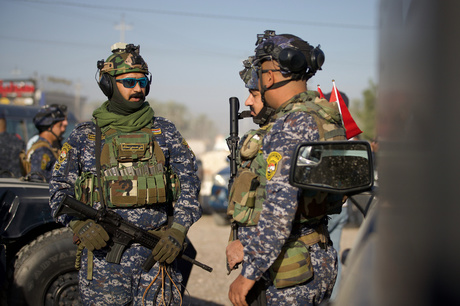
Iraqi Prime Minister Ali al-Zaidi moved to put Kurdistan's border crossings and several oil fields under federal control on Tuesday in an effort to curb oil-smuggling, a step likely to sour relations with the autonomous region.
The premier, who has vowed to fight rampant corruption in Iraq, has been cracking down on the illicit oil trade, arresting officials and challenging an Iran-backed armed group after smuggling was uncovered in its stronghold near Baghdad.
Earlier this month, Zaidi sent an investigation committee to northern Iraq.
Based on its findings, Zaidi's spokesperson Sabah al-Numan said Tuesday "the Border Ports Commission shall assume control of all border crossings in the Kurdistan Region."
He added that Zaidi directed the oil ministry "to manage all oil fields" that are under Kurdish "security authority" despite lying outside the Kurdistan Region, in the provinces of Diyala, Kirkuk, Salaheddine and Nineveh.
Zaidi also ordered the Kurdistan government not to approve oil exports except through the federal oil ministry.
A state oil company official and a government source told AFP that Kurdish security forces took control of several oil wells and facilities outside the Kurdistan Region's administrative borders following the 2003 US-led invasion of Iraq.
The oil fields include the Khurmala field, seized by Kurdistan in 2008. Although located near the Erbil-Kirkuk border, it administratively belongs to Kirkuk province.
The government statement did not specify when or how the takeover of the border crossings and oil fields would be implemented.
- 'Unacceptable' -
Kurdistan Region Prime Minister Masrour Barzani said his government was "surprised" by Zaidi's decisions, calling them "completely unacceptable".
Despite their internal feud, Kurdistan's two ruling parties -- the Kurdistan Democratic Party and the Patriotic Union of Kurdistan -- issued a joint statement calling for disputes with Baghdad to be resolved in accordance with the constitution, warning that "violating" the region's "rights and gains is a red line".
Relations between Baghdad and Kurdish authorities have often been strained by disputes over lucrative oil exports.
In 2025, Iraq resumed crude exports from Kurdistan through an Iraq-Turkey pipeline after a more than two-year halt over legal and technical disputes. Before the halt, Kurdish authorities had exported oil independently, without the approval or oversight of the federal government.
Barzani stressed the importance of "protecting the Kurdistan Region and safeguarding its experience".
Still, he said "we will continue the dialogue... and the door is open" to an agreement on all outstanding issues.
A former oil ministry official told AFP that the Kurdistan Region had long exported oil to Turkey not only via a pipeline but huge quantities via tanker trucks.
He also added that "illicit crossings in Kurdistan are used to smuggle crude oil, including from other parts of Iraq, to neighboring countries".
The Kurdistan region shares borders with Turkey, Syria and Iran.
On Tuesday, Zaidi also dismissed the head of Iraq's border crossings authority, suspended the chief of the state-owned North Oil Company, and removed several security officials in the oil-rich province of Kirkuk, which borders Kurdistan.
He also ordered the closure of all "unofficial crossings," tighter security at oil fields, and the deployment of oil ministry personnel at checkpoints on the entrances of Kurdistan's three provinces.
Zaidi's latest move comes after tensions with the Tehran-backed armed group Kataeb Hezbollah nearly escalated into a confrontation when his government said that oil smuggling activities were taking place in the faction's stronghold of Jurf al-Sakher, south of Baghdad.
He later sent government forces into Jurf al-Sakher under a compromise deal that averted a confrontation.
Iraq is a founding member of the OPEC cartel, and crude oil sales make up 90 percent of the country's revenues.
Its oil exports were severely disrupted during the Middle East war due to the disruption of the Strait of Hormuz, the main route for Iraq's crude shipments, and have only recently recovered.

