


Residents of Tripoli lose neighbors, livelihoods in building collapse
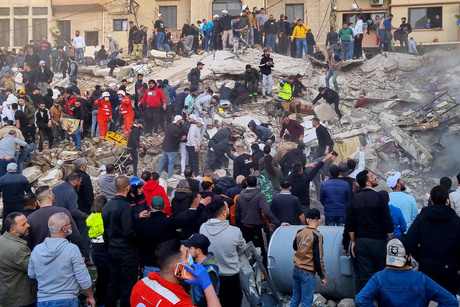
Rubble is all that remains of the building once home to Adnan Mardash's grocery shop in north Lebanon's Tripoli after it collapsed, killing 14 people and shining a spotlight on the impoverished city's neglect.
Mardash, 54, said he shut the small ground-floor store where he worked for more than three decades and went to his nearby home shortly before the disaster on Sunday afternoon.
"Our neighbors and loved ones died... people lost their livelihoods," said the father of four, who has no other income.
"We felt the building's situation wasn't good and we contacted the municipality but got no response," he told AFP.
Only eight people were pulled out alive after the building, home to 12 apartments, collapsed in the Bab al-Tabbaneh neighborhood.
People were angry and grieving on Monday, some peering over balconies to watch emergency workers remove debris after the disaster, which came just over two weeks after another building in the city collapsed, killing two people.
"Officials come, put on a show then leave, they're all liars... nobody cares about the poor people. If an official had lived in this building, it would have been fixed in seconds," Mardash said.
Naser Fadel, 60, who has lived all his life in the neighborhood, stood at his small store weeping.
"We live here in extreme poverty. We've gone through wars... There are no words to express what we have been through," he said.
Those who died were "the best people, they were poor and humble", he said.
- 'Rich people' -
Even before a years-long economic crisis began in Lebanon in 2019, more than half of the city's residents lived at or below the poverty line, according to the United Nations.
The building that collapsed is on a crowded street that divides the predominantly Sunni Bab al-Tabbaneh neighborhood from the mainly Alawite Jabal Mohsen.
Buildings still bear the scars of recurring clashes between the two neighborhoods from 2007 to 2014.
The fighting, and a 2023 earthquake that hit Turkey and neighboring Syria, which is not far from Tripoli, worsened the situation.
The Tripoli municipality on Sunday declared the city "disaster-stricken" and urged the Lebanese state to bear its responsibilities.
After an emergency cabinet meeting on Monday, Prime Minister Nawaf Salam said authorities had decided to evacuate 114 buildings at risk of collapse and provide a year of housing allowances for the affected families.
Authorities will also begin reinforcing buildings that are able to be rehabilitated "and demolishing those at risk of collapse", he said.
Tripoli Mayor Abdel Hamid Karimeh told AFP that at least 600 buildings needed "direct intervention to reinforce them", but warned that the real number could be much higher.
He said the municipality has recently evacuated 12 buildings and relocated residents to a hospitality institute.
In the Qubbeh neighborhood near Bab al-Tabbaneh, Yousef Ahmad, 80, had moved in with his daughter after losing his home in last month's deadly building collapse.
"Nobody has given us any help... there are lawmakers and rich people" in the city but "nobody asks about our situation", he lamented.
- 'Without oversight' -
Lebanon is dotted with derelict buildings, and many inhabited structures are in an advanced state of disrepair.
Several buildings have collapsed before in Tripoli and other parts of the country over the years, with the authorities failing to take appropriate measures to ensure structural safety.
Many buildings were built illegally, especially during the 1975-1990 civil war, while some owners have added new floors to existing residential blocks without permits.
Abir Saksouk, co-founder of research and design firm Public Works Studio, said authorities had allowed buildings to fall into disrepair and noted a lack of oversight and legislative gaps.
She said a public safety decree dating to the early 2000s fails to provide a mechanism for restoring buildings constructed before it was issued.
Many buildings were also built "without oversight", she told AFP, while decrying neglect of the issue and "unjust housing policies".
Many residents have little choice but to stay in their dilapidated homes.
Mohammed al-Sayed, 56, has remained in his building despite pieces falling from a second-floor balcony.
He said the municipality had repeatedly warned about cracks after four additional floors were built on the original two.
But he said he was unable to leave the building where he has spent almost his whole life.
"I have no shelter or alternative place to live," he said.


