


Israel unleashes deadly strikes across south Lebanon despite latest truce
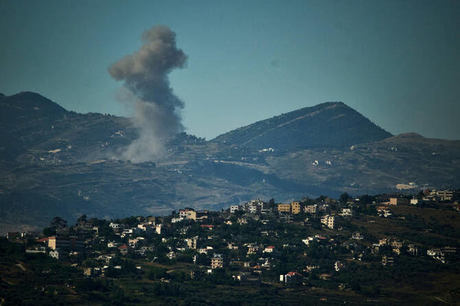
Israel carried out deadly strikes in south Lebanon on Saturday and Hezbollah maintained it had the right to respond, hours after the United States announced a renewed ceasefire in fighting that had strained a fledgling deal with Iran.
A strike on the village of Barish killed four members of a family, parents and two children. In Arab Salim village, a body was pulled from a destroyed house, and in the villages of Doueir and Kfar Rumman, drone strikes killed a person on a motorcycle and a Lebanese soldier. Nine people were killed in strikes in the villages of Qannarit, Sohmor and Shehour.
Plumes of smoke rose into the sky over southern Lebanon Saturday and Israeli jets flew low over the coastal city of Tyre.
The city's residents told The Associated Press they were relieved that Tyre had been spared in recent days but the sounds of Israeli planes reminded them the war is not over. Many doubted a ceasefire — even if agreed on — would hold.
“Our entire lives would change if there’s a ceasefire,” said Hussein Khoshman, a Tyre resident.
U.S. President Donald Trump and his Iranian counterpart Masoud Pezeshkian this week signed a preliminary agreement to halt the Middle East war on all fronts, including Lebanon -- a key demand of Tehran's.
But follow-up talks scheduled for Friday in Switzerland were indefinitely postponed as Israel launched a wave of strikes in Lebanon that left dozens of people dead after four of its soldiers were killed in combat, sparking a furious reaction at home.
On Friday afternoon, a U.S. official announced a new ceasefire between Israel and Hezbollah brokered by U.S. and Qatari mediators, with Israel's ambassador to Washington saying it would respect the truce if Hezbollah did.
But on Saturday an Israeli military official said it was conducting fresh attacks against the Iran-backed movement, which it accused of having "launched more than 50 projectiles at Israeli forces in southern Lebanon" overnight.
Lebanese state media reported Israeli air raids on around 20 locations, with the country's civil defense agency saying 16 people were killed in the Nabatieh area, where an AFP photographer saw smoke rising over the city after strikes.
Lebanese official media later said an Israeli strike on a village near the southern city of Sidon killed at least seven people.
The strike on Qannarit killed "seven people and wounded 13 others, in a preliminary toll", the state-run National News Agency (NNA) said.
An AFP journalist on the Israeli side of the border also reported multiple explosions in Lebanon, with smoke billowing behind the historic Beaufort Castle, a strategic position not far from Nabatieh that Israel captured last month.
- 'Right to confront -
Hezbollah lawmaker Hassan Fadlallah said Saturday that his group insisted "that the enemy fully and comprehensively respect the ceasefire".
"The resistance has the full right to confront this enemy when it attacks us, as it is the aggressor and the occupier," he added.
An Israeli military official cited by public broadcaster Kan, meanwhile, similarly described Israel's approach to the truce as being "on the basis of fire being answered with fire".
Lebanese authorities reported 47 people were killed in Israeli airstrikes on Friday, the highest toll since the U.S. and Iran struck their deal to stop the wider regional war.
Hezbollah had pulled Lebanon into the conflict in early March when it fired rockets at Israel in retaliation for the killing of Iran's supreme leader in U.S.-Israeli strikes.
A previous ceasefire meant to take effect in Lebanon in April was never honored, with both sides justifying their ongoing attacks by the other's violations.
Israel and Lebanon, which have no official diplomatic ties, have held multiple rounds of U.S.-mediated direct talks in Washington, with another scheduled next week.
Meanwhile, talks that were scheduled to take place between the U.S. and Iran in Switzerland to build on the preliminary deal and work towards a lasting settlement in the wider Middle East war were postponed Friday, with no new date announced.
Vice President JD Vance had been expected to represent the American side, but put off his trip.
Instead, U.S. envoy Steve Witkoff headed to Switzerland to get the talks back on track, American media outlets reported, with fellow Trump emissary Jared Kushner also expected there.
In parallel, mediator Pakistan's interior minister Mohsin Naqvi arrived in Iran on Saturday for meetings with officials including Foreign Minister Abbas Araghchi.
Iranian foreign ministry spokesman Esmaeil Baqaei had said the visit was "part of Pakistan's efforts regarding the Iran-US negotiations".
The talks in Switzerland were due to kick off a two-month period of negotiations to discuss outstanding issues not covered by the initial deal, notably Iran's nuclear program.
Switzerland's foreign ministry confirmed the discussions had been postponed but said it "remains ready to facilitate these talks".
Iranian foreign ministry spokesman Esmaeil Baqaei said Friday that there was "no urgency to hold the meeting", but that it was planned "in the coming days."


